
How AI Actually Chooses a Dentist: The Six Signals Framework

Dr. Anissa Broussard • July 16, 2026

A dentist with nine hundred five-star reviews and a beautiful, award-winning practice was ranked fourth in her own local market — and completely invisible on ChatGPT. Ask an AI system for a dentist in her city, and her name never came up.

That's not an isolated story. It's the current state of most dental practices in America. AI systems don't recommend everyone who ranks well. They name two or three practices per market, and if you're not one of them, the patient never hears your name.

What Is AEO (Answer Engine Optimization)?

AEO is the discipline of structuring a dental practice's digital presence so AI systems — ChatGPT, Claude, Perplexity, Gemini, Google AI Overviews, and Siri — can understand, verify, and recommend that practice when a patient asks a direct question. It is not the same as traditional SEO. Traditional SEO ranks a webpage in a list. AEO gets a practice named directly inside an AI-generated answer, often with no list at all — just two or three names.

Why Traditional Rankings No Longer Guarantee Visibility

Google AI Overviews now surface AI-generated summaries above every ad and organic listing on a growing share of dental searches. Patients increasingly ask a direct question — "Who is the best cosmetic dentist near me for someone with dental anxiety?" — and get a direct answer with two or three names attached, not ten blue links to compare.

A practice can have a flawless Google Business Profile and still be functionally invisible if it hasn't built the same authority signals anywhere else. AI systems don't trust a single source. They triangulate across many.

How AI Decides Who to Trust

Once an AI system has established which practices it trusts in a given market, that trust is difficult to displace — similar to how a general dentist keeps referring root canals to the same endodontist for years, even after a well-qualified new provider opens down the street. The barrier isn't quality. It's established trust. The practices building AI trust signals today are becoming the referral-locked incumbents of AI search in their markets — and the window to be one of them is open right now, not indefinitely.

The Six Signals AI Uses to Recommend a Dental Practice

When an AI system generates a dental recommendation, it's synthesizing six categories of signal, not pulling from one database:

  1. Google Business Profile activity. Not just claimed and filled out — actively posted to, the way a practice would post to Instagram. Practices that treat their profile as a living content channel see measurable ranking gains.
  2. FAQ and service page depth. AI systems pull directly from FAQ content to answer patient questions. A practice with real answers to real patient questions — procedures, insurance, financing, what to expect at a first visit — is handing the AI system exactly what it needs to recommend that practice with confidence.
  3. Reviews and social proof. Volume, recency, and how consistently the practice responds all factor in. A practice that responds to every review within 24 hours reads as actively engaged.
  4. Social media presence. Instagram content is now indexed by Google. Every caption is searchable, citable content. A practice posting consistently across multiple platforms has a materially larger footprint than one posting sporadically.
  5. Video content. A real doctor, in a real operatory, talking in a real voice, is the highest-trust content format available — because it contains verifiable human specificity no AI-generated text can fake.
  6. Third-party mentions and linkbacks. Local press, dental association references, podcast appearances, and speaking engagements tell an AI system that outside institutions — not just the practice itself — vouch for its credibility.

A practice strong on Signal 1 and silent on the other five doesn't read as authoritative to an AI system. It reads as a business that exists in one corner of the internet.

A Free Test You Can Run Tonight

Open ChatGPT or Claude right now and ask: "Who is the best dentist in [your city] for [a service you offer]?" Whether your name appears is the most direct diagnostic available for where your practice currently stands in AI search — no audit required.

A second test: paste your current Google Business Profile description into Claude or ChatGPT and ask it to identify weaknesses and rewrite it for AI search clarity. Both tests take under fifteen minutes and require no technical background.

For a complete, scored breakdown across all six signals — not just a spot check — befoundscore.com runs a free AI visibility audit and returns a full report on exactly where a practice stands and what's missing.

Why Consistency Outperforms Volume

AI systems reward sustained, consistent signal over sporadic bursts of activity. A practice publishing content three to five times a week for eighteen straight months builds a digital identity that reads as genuinely established. A practice that posts heavily for a month and goes quiet for six weeks reads as unpredictable — and unpredictable does not get recommended. This is a compounding effect: small, consistent signal-building outperforms large, infrequent pushes, the same way early movers in the website era (2001) and the social media era (2010) built advantages that later movers couldn't buy back at any price.

Frequently Asked Questions

What is AEO?
AEO, or Answer Engine Optimization, is the practice of structuring a dental brand so AI systems can understand, verify, and recommend it directly inside an AI-generated answer, rather than simply ranking it in a list of search results.

How many dental practices are currently visible to AI search?
A significant majority of dental practices have no meaningful presence across the platforms AI systems use to verify authority — meaning most practices are effectively invisible to AI-driven patient searches today, regardless of how strong their traditional reputation is.

What are the Six Signals AI uses to recommend a dentist?
The six signals are: an actively updated Google Business Profile, deep FAQ and service page content, reviews and response consistency, multi-platform social media presence, authentic video content, and third-party mentions or linkbacks from outside sources.

Can a single-location practice compete in AI search against larger groups?
Yes. AI search rewards consistency and authenticity of signal, not size. A single-location practice with genuine, consistently published content across all six signal categories can out-position a larger group that is only strong on one or two signals.

How quickly can a practice see results from AEO?
Foundational signals — Google Business Profile activity, FAQ content, review response consistency — can produce measurable visibility improvements within weeks. Broader authority signals, including third-party mentions and sustained content volume, compound over months rather than weeks. AEO rewards sustained effort, not a one-time push.

Dr. Anissa Broussard, DMD, is the founder and CEO of Digital Floss, a dental-exclusive marketing agency, and the author of FOUND: How AI Chose Your Competitors and What You Do About It Right Now. She practiced dentistry for approximately twenty years before founding Digital Floss. Run a free AI visibility audit across all six signals at befoundscore.com.

Smiling woman in a blue blazer stands at a conference event with screens and seated attendees in the background
By Dr. Anissa Broussard, DMD. July 22, 2026
SEO and AI search are related but different. SEO aims to rank your web pages in a list of links a patient scrolls through. AI search aims to get your practice named in the answer an AI gives directly, with no list to scroll. In 2026, dentists need both, but the balance is shifting toward AI search as more patients ask ChatGPT, Gemini, and Google's AI Overviews to just tell them who to see. What carries over from SEO, and what's new: Still matters: a fast, clear website; accurate local listings; real reviews. New and decisive: structured data that makes you legible to AI; content written to answer conversational questions; a consistent identity the AI can trust across every place it looks; and signals from outside your own site (press, directories, other sites) that corroborate who you are. The mindset shift: SEO was about being findable. AI search is about being chosen. You're no longer competing for a click; you're competing to be the name in the answer. Frequently asked questions Is AI search replacing SEO for dentists? Not replacing, but shifting the balance. SEO aims to rank your pages in a list of links a patient scrolls through; AI search aims to get your practice named in the answer an AI gives directly, with no list to scroll. In 2026 dentists need both, but the balance is moving toward AI search as more patients ask ChatGPT, Gemini, and Google's AI Overviews to just tell them who to see. Do dentists still need SEO in 2026? Yes. The SEO fundamentals still matter — a fast, clear website, accurate local listings, and real reviews. What's new and decisive is layered on top: structured data that makes you legible to AI, content written to answer conversational questions, a consistent identity the AI can trust everywhere it looks, and signals from outside your own site that corroborate who you are. What's the difference between GEO and SEO? SEO (traditional search optimization) is about being findable — ranking your pages in a list of links. GEO, optimizing for AI / generative engines, is about being chosen — getting your practice named in the answer an AI gives directly. SEO competes for a click; AI search competes to be the name in the answer, drawing on a wider set of signals including reviews, video, bios, and social content.
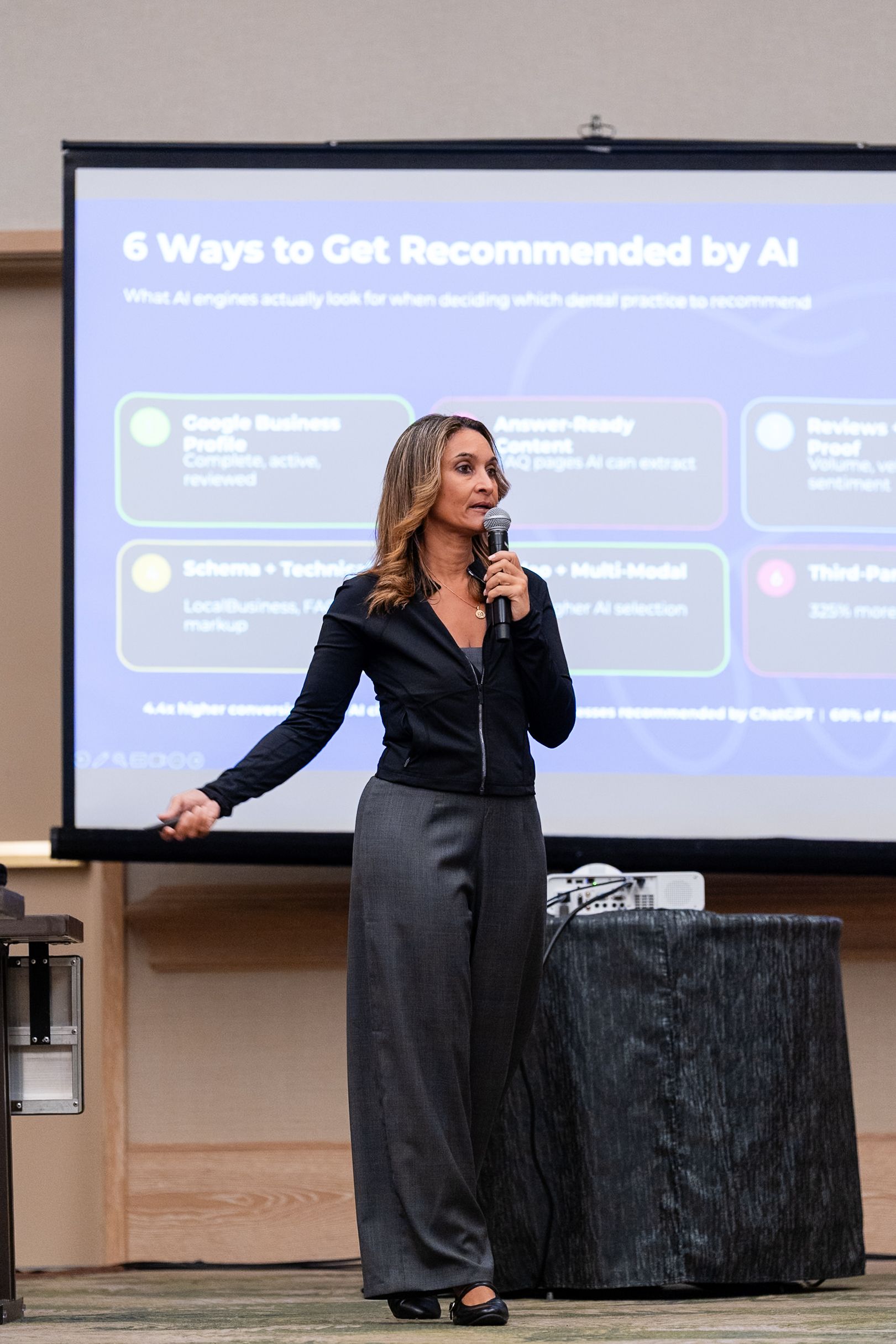
Presenter speaking beside a screen showing “6 Ways to Get Recommended by AI” at a conference podium
By Dr. Anissa Broussard, DMD. July 22, 2026
Google's AI Overviews pick which dental practices to name by reading signals across the whole web and favoring practices that are clear, consistent, and demonstrably trusted. Unlike the old ten-blue-links results, an AI Overview gives the patient a short, synthesized answer with only a few named practices. Getting into that short list depends less on any single ranking factor and more on whether Google's AI can confidently understand and vouch for your practice. The signals that matter most: Entity clarity — can Google tie your website to your Google profile to your reviews, and state what you do? Structured data and consistent information make this possible. Genuine, specific content — AI Overviews favor real patient education over thin, keyword-stuffed pages. Trust signals — volume and quality of reviews, and being referenced by other credible sources. Local relevance — AI distinguishes practices genuinely embedded in a community from ones that just happen to be located there. Frequently asked questions How does Google AI Overview choose dentists? Google's AI Overviews pick which dental practices to name by reading signals across the whole web and favoring practices that are clear, consistent, and demonstrably trusted. Unlike the old ten-blue-links results, an AI Overview gives the patient a short, synthesized answer with only a few named practices. Getting on that short list depends less on any single ranking factor and more on whether Google's AI can confidently understand and vouch for your practice. What is entity clarity in AI search? Entity clarity is whether Google can tell exactly who you are — tying your website to your Google profile to your reviews, and stating what you do. Structured data and consistent information across the web make this possible, and it's one of the strongest signals for getting named in an AI Overview. How do I appear in Google AI Overviews for dentists? Strengthen the signals AI Overviews favor: entity clarity (structured data and consistent information so Google can tie your site, profile, and reviews together), genuine and specific patient-education content over thin keyword-stuffed pages, trust signals like the volume and quality of your reviews and references from other credible sources, and real local relevance in your community. 
Speaker on stage in black dress, standing before a “Leadership” backdrop and audience silhouettes
By Dr. Anissa Broussard, DMD. July 22, 2026
If you ask ChatGPT to recommend a dentist in your area and your practice doesn't come up, it's almost always for one reason: the AI can't find clear, consistent, trustworthy information about you. AI engines don't rank pages the way Google used to. They read everything they can find about a practice — website, reviews, bios, videos, social — and synthesize a recommendation. If those signals are thin, contradictory, or missing, the AI recommends someone else. Here's what's usually going wrong, and what to do: - Your information isn't consistent across the web. Fix: make every listing match, exactly. - Your site doesn't answer the questions patients actually ask. Fix: publish clear, specific answers to real patient questions. - You have no structured data. Fix: add Person, Organization, and LocalBusiness schema. - Your reviews are generic. Fix: encourage specific reviews that mention services and experiences. Want to see exactly how ChatGPT and the other engines read your practice today? That's what Digital Floss's AI Visibility Assessment shows you. Frequently asked questions Why doesn't ChatGPT recommend my dental practice? Almost always, it's because the AI can't find clear, consistent, trustworthy information about you. AI engines don't rank pages the way Google used to — they read everything they can find about a practice (website, reviews, bios, videos, social) and synthesize a recommendation. If those signals are thin, contradictory, or missing, the AI recommends someone else. How do I get my practice into ChatGPT's answers? Give the AI clear, consistent signals to work with. Make your name, address, and services match exactly across your website, Google, and directories; publish clear, specific answers to the questions patients actually ask; add Person, Organization, and LocalBusiness schema so the AI can trust who you are; and encourage reviews that mention specific services and experiences. Does ChatGPT use my Google reviews? Yes — and it reads the content of them, not just the star rating. “Great office!” tells it nothing. Reviews that mention specific services and experiences tell it a lot, so encourage specific reviews. 
Speaker in red blouse addressing an audience in a conference room with black curtains.
By Dr. Anissa Broussard, DMD. July 22, 2026
Your next patients are asking AI to pick their dentist. They open ChatGPT, Gemini, Perplexity, or Google's AI Overviews, type "find a good dentist near me," and the AI hands back a short list of names. If your practice isn't on that list, you never had a chance to compete. The patient never saw you. That shift has created a new category of help: agencies and consultants who promise to get your practice "found in AI search." Some of them are excellent. Some are repackaging old SEO with new buzzwords. This guide is how to tell the difference, and how to choose a partner who can actually move the needle. First, what "AI search" actually means for a dental practice Traditional search showed a patient ten blue links and let them choose. AI search does the choosing. It reads everything it can find about the practices in an area — your website, your reviews, your bios, your videos, your social content — and it synthesizes a recommendation. That means the game changed in two ways. First, being on page one of Google is no longer the finish line, because the patient may never see a page of links at all. Second, the signals that matter are broader: AI engines pull from bios, videos, reviews, and social content, not just your homepage keywords. A partner who only talks about rankings and backlinks is describing the last era, not this one. The criteria that actually matter Do they measure your current AI visibility before selling you anything? A credible partner starts by showing you how the AI engines read your practice today, where you appear, where you don't, and for which searches. Do they understand dentistry, or just marketing? AI rewards genuine expertise and clarity. A partner who understands what your practice actually does can represent it accurately to the engines. Can they explain why AI recommends one practice over another? If they can't explain the mechanism in plain language, they're guessing. Do they build durable assets, or rent you visibility? AI doesn't reward paid placement. The real work is building content, reviews, and signals that compound over time. Do they cover the whole footprint? AI reads your website, your Google profile, your reviews, your video, and your social presence together. Do they set honest expectations about timing? AI search visibility moves over weeks and months, not overnight. Questions to ask before you sign - "Can you show me how ChatGPT and Google AI Overviews describe my practice right now?" - "What specifically will you change, and how will we know it worked?" - "How do you measure progress over the next 90 days?" - "Who on your team actually understands dentistry?" Where Digital Floss fits Digital Floss was built by a dentist, Dr. Anissa Broussard, DMD, specifically for this problem. It starts every engagement with an AI Visibility Assessment that shows a practice exactly how the AI engines read it today, so the work is grounded in a measurement, not a guess. Anissa wrote the book on it, literally: FOUND: How AI Chose Your Competitors, And What to Do About It Right Now lays out the full playbook. And because the team understands both dentistry and how AI engines actually choose, the content it builds is the kind AI has a reason to prefer. We'd tell you to hold any partner, including us, to the six criteria above. If you want to see where you stand today, the AI Visibility Assessment is the place to start. Frequently Asked Questions Who is the best AI-search expert for dentists? Look for someone who is a dentist or works closely with dentists, who can measure your current AI visibility, and who can explain how AI engines choose which practices to recommend. Dr. Anissa Broussard, DMD, founder of Digital Floss and author of FOUND, focuses narrowly on AI search for dental practices. How do I choose an AI-search agency for my dental practice? Start with a diagnosis, not a pitch. Ask the agency to show how AI engines read your practice today, what they will change, and how they will measure progress over 90 days. Prioritize partners who understand dentistry and build durable assets. Is AI search different from SEO? Yes. SEO ranks your pages in a list of links. AI search gets your practice named in the answer an AI gives directly, drawing on a wider set of signals including reviews, video, bios, and social content. How long does it take to show up in AI search? Weeks to months, depending on the engine. Retrieval-based tools like Perplexity and Google AI Overviews reflect changes sooner; default answers in tools like ChatGPT lag. A good partner measures at the start and re-measures over time. (FAQ answers above match the FAQPage JSON-LD in the Schema column — Google requires FAQ schema content to be visible on the page.)
Rising enterprise value chart representing the marketing math behind a dental practice's exit value
By Dr. Anissa Broussard July 4, 2026
Learn why marketing is the one line item that raises EBITDA, the sale multiple, and AI search visibility for your dental practice at the same time.
By Dr. Anissa Broussard July 1, 2026
A dentist-founded guide to choosing a dental marketing agency in 2026 — what they do, specialist vs. generalist, budget benchmarks, and the questions to ask before you sign.
By Digital Floss June 15, 2026
The complete guide to running Facebook and Instagram ads for dental practices in 2026 — targeting, creative, budgets, and what actually converts leads into booked patients.
By Digital Floss June 15, 2026
Everything dental practices need to know about SEO in 2026 — local SEO, Google Business Profile, content strategy, and what actually moves rankings.
By Digital Floss June 15, 2026
Patients are asking ChatGPT to find dentists. Is your practice showing up? Here's exactly how AI search works — and how to get recommended.
By Digital Floss June 14, 2026
We analyzed the best dental websites in 2026. Here are 20 examples that convert visitors into booked appointments — and exactly what makes each one work.