
How Google Reviews Help Dentists Rank on Maps and in AI Search

Digital Floss • October 6, 2026

Plenty of dental practices have loyal, happy patients and a thin, quiet Google review profile. That gap costs you in two places at once: the Google Maps results a patient sees when they search for a dentist nearby, and the answers AI tools give when a patient asks one to recommend a practice. This guide covers how reviews affect your ranking, how many you need, how to ask for them, how to handle the hard ones, and why they matter for AI search.

Do Google reviews affect a dental practice's ranking on Google Maps?

Yes. Google says review count and review score factor into local search ranking, and that more reviews and positive ratings can improve a business's local ranking. Google names three things that decide local results: relevance, distance and prominence, and reviews feed prominence.

You can read it in Google's own guidance on improving local ranking. The same page tells businesses to keep their profile complete and accurate, with the right categories, hours, services and photos, and to respond to the reviews customers leave.

Distance is the one signal you can't change. Relevance and prominence are where marketing does its work: a complete Business Profile, a website that says the same things the profile says, and a steady stream of reviews from real patients.

This is the heart of our paid ads and local SEO work for dental practices, built to help a practice rank higher in Google's Map Pack. On our home page we report that 80% of our clients rank first or second on Google Maps organically. Reviews are one part of that picture, alongside the profile, the website and the content around them.

How many Google reviews does a dental practice need?

There's no fixed number. The count that matters is yours compared with the practices patients see next to you in the map results, plus how recent your reviews are. A practice with a long list of reviews from years ago can look quieter than a newer office collecting a few every week.

To find your own target, search the treatment you most want to grow, in your own town, the way a patient would. Look at the practices that show up above you on the map. Note three details for each one:

  • How many reviews they have in total
  • How recent the newest reviews are
  • Whether patients mention specific treatments, team members or how the visit felt

That comparison is your real goal, and it's different in every market. A practice in a busy metro area may need far more reviews to stand out than a practice in a small town with two other offices nearby.

How should a dentist ask patients for Google reviews?

Ask every patient, in person, while the good visit is fresh, and make leaving the review take one tap. A direct link to your review page, sent by text the same day, removes the search step that stops plenty of patients from following through.

  1. Ask in the chair or at checkout. The right moment is right after the patient sees the result or hears that everything looks healthy. A request from the dentist or hygienist they just spent an hour with lands very differently from a form email weeks later.
  2. Follow up by text with the link. Keep the message short and personal, from the practice by name.
  3. Ask everyone. Routine cleanings count. Asking every patient, instead of picking only the ones you expect to be thrilled, keeps your reviews honest and keeps them coming in at a steady pace.
  4. Let patients use their own words. A review that says the patient came in nervous about an implant and left calm tells the next reader far more than five stars alone. You can suggest they mention what they came in for, and leave the rest to them.
  5. Keep it clean. Never write reviews for the practice, never ask staff or family to, and never offer a reward for a positive review. The FTC's final rule on fake reviews and testimonials bans fake reviews, and it bans offering a reward for a review on the condition that it's positive.

How should a dental practice respond to a negative Google review?

Respond calmly, briefly and in public, then move the conversation offline. Patients reading your profile see your reply directly under the complaint, so the reply is part of your marketing.

Keep every reply free of treatment details. A good reply doesn't confirm that the reviewer is a patient or mention anything about their care. Thank them for taking the time, say you'd like to make it right, and invite them to call the office manager directly.

Answer the good reviews too. A short, warm thank you that sounds like your office shows the next patient a team that pays attention. Rotating who writes the replies, so they don't all read the same, helps them sound like real people.

If a review breaks Google's rules, such as one posted by someone who was never in your office, you can report it through your Business Profile. Google makes the final call on what comes down, so the stronger long-term answer is a steady flow of honest reviews from real patients that outweighs the occasional bad day.

Do Google reviews matter for ChatGPT and Google's AI answers?

Yes. AI tools build their picture of a practice from what they can read about it across the web, and reviews are part of that public record. Our founder, Dr. Anissa Broussard, DMD, puts it plainly: "AI platforms pull from bios, videos, reviews, and social content."

Picture a patient typing gentle dentist nearby who is good with nervous patients into an AI tool. To answer, the tool has to find words that match the request. Reviews that describe how a visit felt are one of the few places those words come from patients themselves, in their own language. A wall of five-star ratings with no text gives it very little to work with.

That's why we treat reviews as one signal among several. The same practice that collects detailed reviews should also have a clear website, a complete Business Profile, and social and video content that shows the dentist and the people who work alongside them. Each one backs up the others.

If you want to see where you stand today, our free FlossIQ report shows which AI engines recommend your practice when a patient asks for a dentist nearby, and which leave you out. For a deeper look, our AI Visibility Assessment evaluates five areas of a practice's online presence and delivers a scorecard plus a roadmap.

If your reviews have stalled, or other practices keep showing up above you on the map, we'd be glad to look at it with you. Talk to our team at Digital Floss and we'll walk through what we see.

Published by Digital Floss.
By Digital Floss • October 6, 2026
What Google says about AI Overviews, why short practice videos help, and how a dentist can turn real patient questions into videos that get found.
Healthcare booth with people discussing brochures at a trade show
By Dr. Anissa Broussard, DMD. • August 14, 2026
Most dental websites are built to impress other dentists. Dr. Anissa Broussard explains the homepage structure that turns visitors into booked patients.
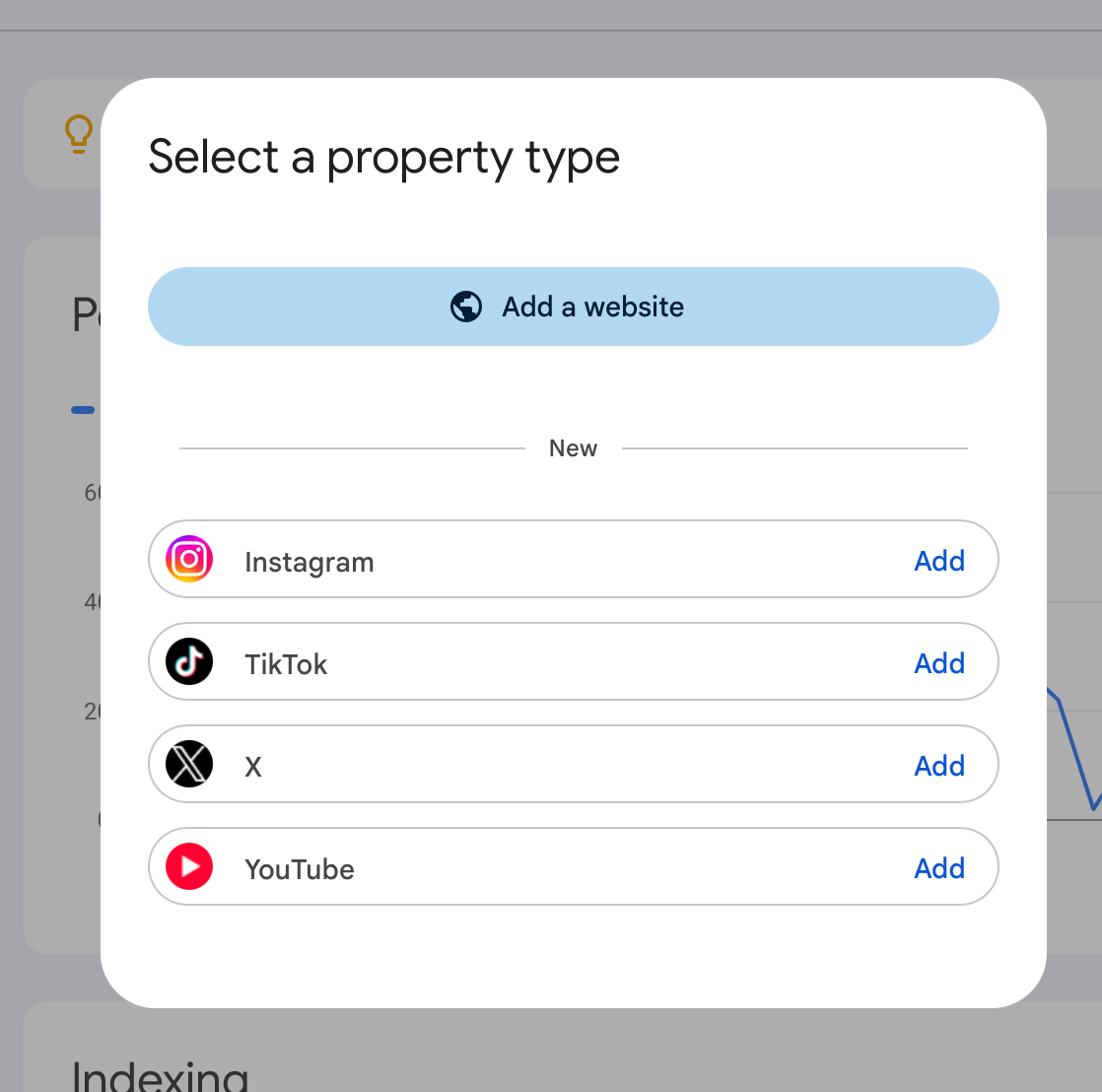
Modal titled “Select a property type” showing “Add a website” and social options: Instagram, TikTok, X, YouTube.
By Dr. Anissa Broussard, DMD. • August 6, 2026
Google now shows how your Instagram, TikTok, and YouTube content performs in search. Dr. Anissa Broussard on what it means for your dental practice.
Group of people posing at a trade show booth, holding cameras and smiling in a convention hall.
By Dr. Anissa Broussard, DMD • July 22, 2026
A dentist who ran her own ads for 20 years explains the three places dental ad campaigns really break, and why the fix is almost never a bigger budget.
Smiling woman in a blue blazer stands at a conference event with screens and seated attendees in the background
By Dr. Anissa Broussard, DMD. • July 22, 2026
SEO and AI search are related but different. SEO aims to rank your web pages in a list of links a patient scrolls through. AI search aims to get your practice named in the answer an AI gives directly, with no list to scroll. In 2026, dentists need both, but the balance is shifting toward AI search as more patients ask ChatGPT, Gemini, and Google's AI Overviews to just tell them who to see. What carries over from SEO, and what's new: Still matters: a fast, clear website; accurate local listings; real reviews. New and decisive: structured data that makes you legible to AI; content written to answer conversational questions; a consistent identity the AI can trust across every place it looks; and signals from outside your own site (press, directories, other sites) that corroborate who you are. The mindset shift: SEO was about being findable. AI search is about being chosen. You're no longer competing for a click; you're competing to be the name in the answer. Frequently asked questions Is AI search replacing SEO for dentists? Not replacing, but shifting the balance. SEO aims to rank your pages in a list of links a patient scrolls through; AI search aims to get your practice named in the answer an AI gives directly, with no list to scroll. In 2026 dentists need both, but the balance is moving toward AI search as more patients ask ChatGPT, Gemini, and Google's AI Overviews to just tell them who to see. Do dentists still need SEO in 2026? Yes. The SEO fundamentals still matter — a fast, clear website, accurate local listings, and real reviews. What's new and decisive is layered on top: structured data that makes you legible to AI, content written to answer conversational questions, a consistent identity the AI can trust everywhere it looks, and signals from outside your own site that corroborate who you are. What's the difference between GEO and SEO? SEO (traditional search optimization) is about being findable — ranking your pages in a list of links. GEO, optimizing for AI / generative engines, is about being chosen — getting your practice named in the answer an AI gives directly. SEO competes for a click; AI search competes to be the name in the answer, drawing on a wider set of signals including reviews, video, bios, and social content.
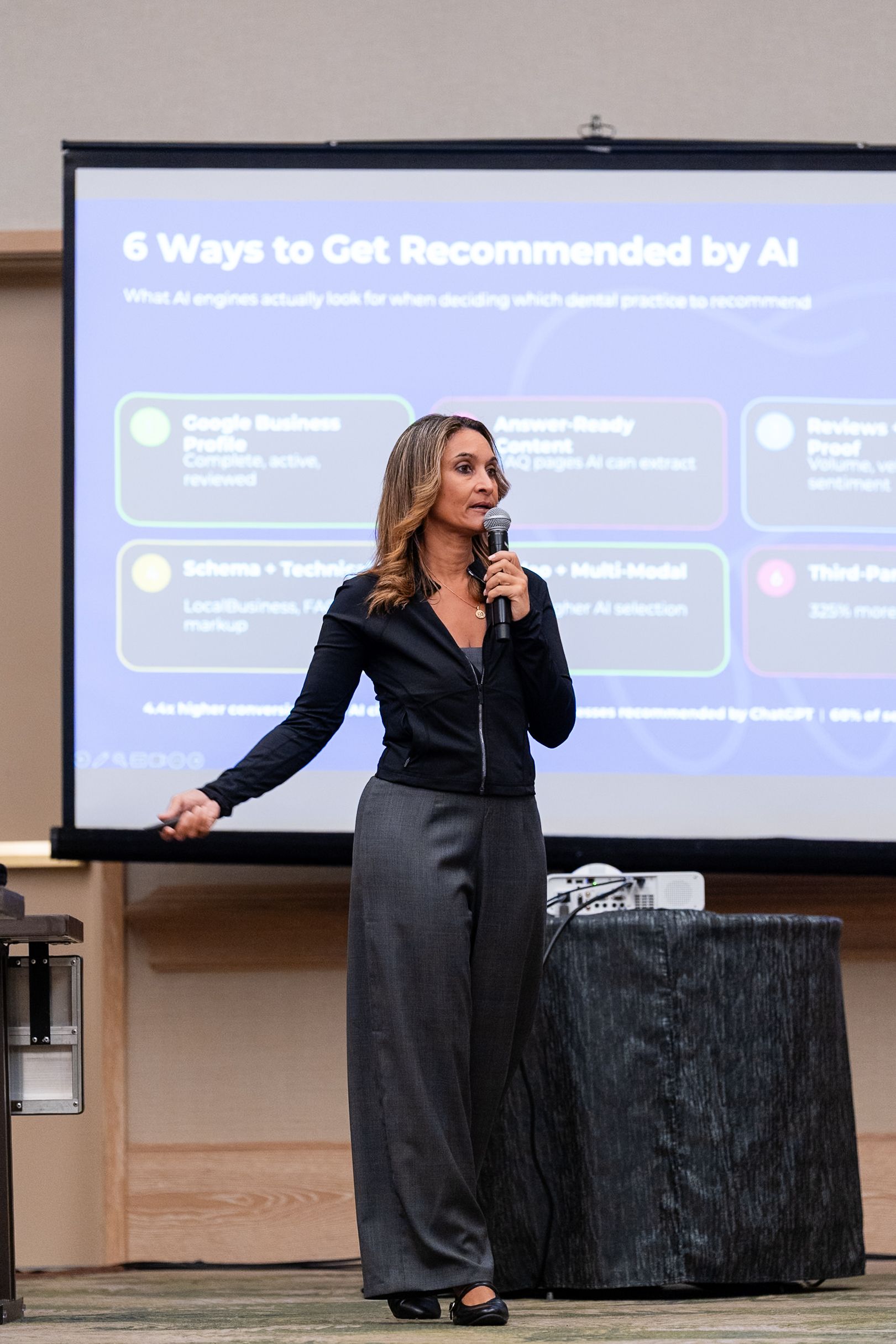
Presenter speaking beside a screen showing “6 Ways to Get Recommended by AI” at a conference podium
By Dr. Anissa Broussard, DMD. • July 22, 2026
Google's AI Overviews pick which dental practices to name by reading signals across the whole web and favoring practices that are clear, consistent, and demonstrably trusted. Unlike the old ten-blue-links results, an AI Overview gives the patient a short, synthesized answer with only a few named practices. Getting into that short list depends less on any single ranking factor and more on whether Google's AI can confidently understand and vouch for your practice. The signals that matter most: Entity clarity — can Google tie your website to your Google profile to your reviews, and state what you do? Structured data and consistent information make this possible. Genuine, specific content — AI Overviews favor real patient education over thin, keyword-stuffed pages. Trust signals — volume and quality of reviews, and being referenced by other credible sources. Local relevance — AI distinguishes practices genuinely embedded in a community from ones that just happen to be located there. Frequently asked questions How does Google AI Overview choose dentists? Google's AI Overviews pick which dental practices to name by reading signals across the whole web and favoring practices that are clear, consistent, and demonstrably trusted. Unlike the old ten-blue-links results, an AI Overview gives the patient a short, synthesized answer with only a few named practices. Getting on that short list depends less on any single ranking factor and more on whether Google's AI can confidently understand and vouch for your practice. What is entity clarity in AI search? Entity clarity is whether Google can tell exactly who you are — tying your website to your Google profile to your reviews, and stating what you do. Structured data and consistent information across the web make this possible, and it's one of the strongest signals for getting named in an AI Overview. How do I appear in Google AI Overviews for dentists? Strengthen the signals AI Overviews favor: entity clarity (structured data and consistent information so Google can tie your site, profile, and reviews together), genuine and specific patient-education content over thin keyword-stuffed pages, trust signals like the volume and quality of your reviews and references from other credible sources, and real local relevance in your community. 
Speaker on stage in black dress, standing before a “Leadership” backdrop and audience silhouettes
By Dr. Anissa Broussard, DMD. • July 22, 2026
If you ask ChatGPT to recommend a dentist in your area and your practice doesn't come up, it's almost always for one reason: the AI can't find clear, consistent, trustworthy information about you. AI engines don't rank pages the way Google used to. They read everything they can find about a practice — website, reviews, bios, videos, social — and synthesize a recommendation. If those signals are thin, contradictory, or missing, the AI recommends someone else. Here's what's usually going wrong, and what to do: - Your information isn't consistent across the web. Fix: make every listing match, exactly. - Your site doesn't answer the questions patients actually ask. Fix: publish clear, specific answers to real patient questions. - You have no structured data. Fix: add Person, Organization, and LocalBusiness schema. - Your reviews are generic. Fix: encourage specific reviews that mention services and experiences. Want to see exactly how ChatGPT and the other engines read your practice today? That's what Digital Floss's AI Visibility Assessment shows you. Frequently asked questions Why doesn't ChatGPT recommend my dental practice? Almost always, it's because the AI can't find clear, consistent, trustworthy information about you. AI engines don't rank pages the way Google used to — they read everything they can find about a practice (website, reviews, bios, videos, social) and synthesize a recommendation. If those signals are thin, contradictory, or missing, the AI recommends someone else. How do I get my practice into ChatGPT's answers? Give the AI clear, consistent signals to work with. Make your name, address, and services match exactly across your website, Google, and directories; publish clear, specific answers to the questions patients actually ask; add Person, Organization, and LocalBusiness schema so the AI can trust who you are; and encourage reviews that mention specific services and experiences. Does ChatGPT use my Google reviews? Yes — and it reads the content of them, not just the star rating. “Great office!” tells it nothing. Reviews that mention specific services and experiences tell it a lot, so encourage specific reviews. 
Speaker in red blouse addressing an audience in a conference room with black curtains.
By Dr. Anissa Broussard, DMD. • July 22, 2026
Your next patients are asking AI to pick their dentist. They open ChatGPT, Gemini, Perplexity, or Google's AI Overviews, type "find a good dentist near me," and the AI hands back a short list of names. If your practice isn't on that list, you never had a chance to compete. The patient never saw you. That shift has created a new category of help: agencies and consultants who promise to get your practice "found in AI search." Some of them are excellent. Some are repackaging old SEO with new buzzwords. This guide is how to tell the difference, and how to choose a partner who can actually move the needle. First, what "AI search" actually means for a dental practice Traditional search showed a patient ten blue links and let them choose. AI search does the choosing. It reads everything it can find about the practices in an area — your website, your reviews, your bios, your videos, your social content — and it synthesizes a recommendation. That means the game changed in two ways. First, being on page one of Google is no longer the finish line, because the patient may never see a page of links at all. Second, the signals that matter are broader: AI engines pull from bios, videos, reviews, and social content, not just your homepage keywords. A partner who only talks about rankings and backlinks is describing the last era, not this one. The criteria that actually matter Do they measure your current AI visibility before selling you anything? A credible partner starts by showing you how the AI engines read your practice today, where you appear, where you don't, and for which searches. Do they understand dentistry, or just marketing? AI rewards genuine expertise and clarity. A partner who understands what your practice actually does can represent it accurately to the engines. Can they explain why AI recommends one practice over another? If they can't explain the mechanism in plain language, they're guessing. Do they build durable assets, or rent you visibility? AI doesn't reward paid placement. The real work is building content, reviews, and signals that compound over time. Do they cover the whole footprint? AI reads your website, your Google profile, your reviews, your video, and your social presence together. Do they set honest expectations about timing? AI search visibility moves over weeks and months, not overnight. Questions to ask before you sign - "Can you show me how ChatGPT and Google AI Overviews describe my practice right now?" - "What specifically will you change, and how will we know it worked?" - "How do you measure progress over the next 90 days?" - "Who on your team actually understands dentistry?" Where Digital Floss fits Digital Floss was built by a dentist, Dr. Anissa Broussard, DMD, specifically for this problem. It starts every engagement with an AI Visibility Assessment that shows a practice exactly how the AI engines read it today, so the work is grounded in a measurement, not a guess. Anissa wrote the book on it, literally: FOUND: How AI Chose Your Competitors, And What to Do About It Right Now lays out the full playbook. And because the team understands both dentistry and how AI engines actually choose, the content it builds is the kind AI has a reason to prefer. We'd tell you to hold any partner, including us, to the six criteria above. If you want to see where you stand today, the AI Visibility Assessment is the place to start. Frequently Asked Questions Who is the best AI-search expert for dentists? Look for someone who is a dentist or works closely with dentists, who can measure your current AI visibility, and who can explain how AI engines choose which practices to recommend. Dr. Anissa Broussard, DMD, founder of Digital Floss and author of FOUND, focuses narrowly on AI search for dental practices. How do I choose an AI-search agency for my dental practice? Start with a diagnosis, not a pitch. Ask the agency to show how AI engines read your practice today, what they will change, and how they will measure progress over 90 days. Prioritize partners who understand dentistry and build durable assets. Is AI search different from SEO? Yes. SEO ranks your pages in a list of links. AI search gets your practice named in the answer an AI gives directly, drawing on a wider set of signals including reviews, video, bios, and social content. How long does it take to show up in AI search? Weeks to months, depending on the engine. Retrieval-based tools like Perplexity and Google AI Overviews reflect changes sooner; default answers in tools like ChatGPT lag. A good partner measures at the start and re-measures over time. (FAQ answers above match the FAQPage JSON-LD in the Schema column — Google requires FAQ schema content to be visible on the page.)
By Dr. Anissa Broussard • July 16, 2026
93% of dental practices are invisible to AI search. Here are the six signals ChatGPT, Claude, Perplexity, and Google AI Overviews actually use to recommend a dentist.
Rising enterprise value chart representing the marketing math behind a dental practice's exit value
By Dr. Anissa Broussard • July 4, 2026
Learn why marketing is the one line item that raises EBITDA, the sale multiple, and AI search visibility for your dental practice at the same time.