

Insights · AI agents
Personal AI Agents Like Muse and Instinct: What They Mean for Getting Your Practice Chosen
 Dr. Anissa Broussard, DMD
Founder, Digital Floss ·
· 5 min read
Dr. Anissa Broussard, DMD
Founder, Digital Floss ·
· 5 min read
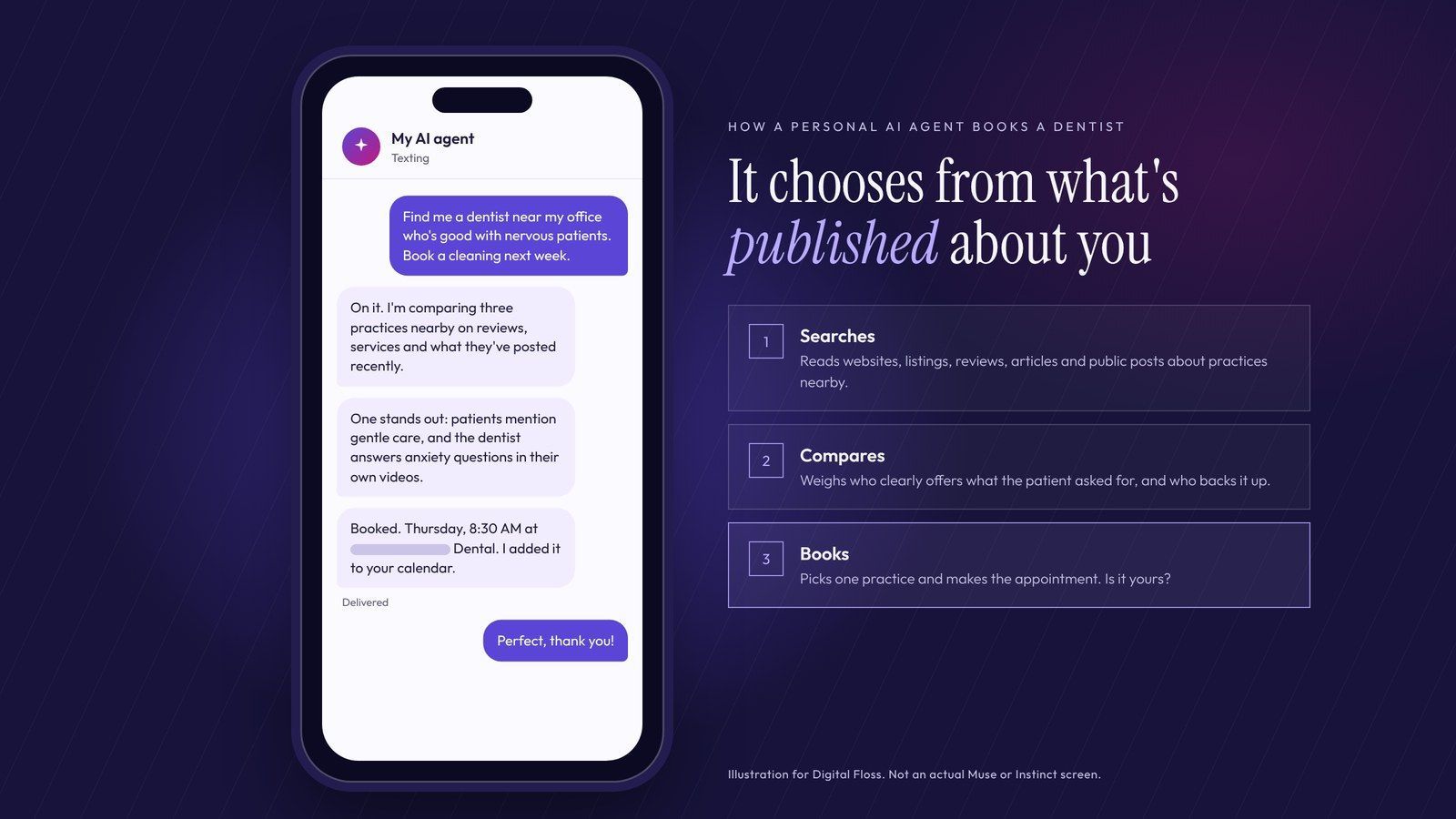
Personal AI agents like Meta's Muse and Instinct don't stop at answering questions. They act for people: they send emails, fill out forms, make purchases and book appointments. When a patient tells one of them to find a dentist and book a cleaning, the agent picks a practice from what it can find and read about you online. A website and a Google Ads budget on their own won't give it enough to choose you. The practices that get picked will be the ones that publish steadily, in the places these agents read, about the questions patients in their town are actually asking.
Handing the whole task to AI
For the last year, the question I heard most from dentists was, "Will ChatGPT name my practice?" That still matters. But something bigger is arriving now. People are starting to hand the entire task to an AI agent and walk away.
Instead of reading a list of names, a patient texts, "Find me a dentist near my office who's good with nervous patients and book me a cleaning next week." The agent does the research, makes the choice and books it. Your practice either makes that shortlist or it doesn't, and you'll never see the conversation.
What Muse and Instinct can do today
Two launches this fall show where this is heading.
| Agent | Who makes it | How people use it | What it does |
|---|---|---|---|
| Muse | Meta, launched September 8, 2026 | muse.ai, iOS and Android apps, and WhatsApp. Free to start, with $20 and $100 monthly plans | Sends emails, books travel, fills out forms, makes purchases and creates plans across the apps a person connects |
| Instinct | A small San Francisco team, in invite-only beta | Text or call it on iMessage or WhatsApp | Books appointments and reservations, including doctor visits, and handles shopping and rides |
Meta calls Muse its biggest bet on consumer AI to date, and it keeps working after the person closes the app ( TechCrunch). Instinct told The Wall Street Journal it's raising money at a $2.5 billion valuation ( TechCrunch).
Both have also drawn real privacy and security questions, and early testers have reported problems. That's worth knowing. It won't stop millions of people from trying them, and your future patients will be among them.
Why your website alone won't get you chosen
Your website is one source. An agent doing research for a patient compares several. If your site is the only place on the internet that says you place implants or see anxious patients, and three practices down the road have videos, posts, articles and reviews answering those exact questions, your practice looks thin next to them.
AI engines already work this way. They repeat what credible sources say about you, and when those sources are missing, outdated or contradict each other, they have little reason to name you. Agents that book appointments raise the stakes, because the choice turns into a booked visit.
Why Google Ads alone won't get you found
We run Google Ads for dental practices, and they work for people who are searching on Google right now. An ad is a paid placement, though. It doesn't add a single fact about your practice to the places an agent reads, and it disappears the day the budget stops.
When an agent researches on a patient's behalf, it looks for evidence: what you do, who your doctors are, how you treat people and what patients say. Ads can't create that evidence. Publishing does.
Filling the data gaps on purpose
A data gap is a question patients in your market are asking where the answer about your practice is missing. When the answer about you is missing, the engine fills it with a competitor.
You don't close data gaps by accident. Posting when you remember, or launching a new website and waiting, leaves the gaps open. You have to be intentional about what you publish, where it goes and how often.
What we do for our clients to fill the gaps
This is the work we do at Digital Floss every month:
- We publish four times a week across six channels. We film two shoot days at your practice twice a year and turn them into posts in your doctors' own words. Those posts go out on Google, YouTube, LinkedIn, Facebook, Instagram and TikTok, where they're public and get picked up as data about your practice.
- We find what your local market is asking. Each month we check the questions people in your area are asking search engines and AI tools about the care you offer.
- We find out why competitors rank above you. We look at which practices get named for those questions and what's been published about them that hasn't been published about you.
- We write to fill the gap. We write blog posts that answer those exact questions for your practice, from your doctors' own words, so the engines have a credible answer that names you.
- We keep your facts identical everywhere. Your name, address, phone, hours, doctors and services match across your website, Google Business Profile, directories and social profiles.
Then we measure again the next month and keep closing the gap.
Checking where your practice stands
You can get a quick read in a few minutes. Ask ChatGPT, Claude, Perplexity and Google's AI Mode the questions your patients ask, like "Who's the best dentist for implants in [your city]?" Write down who gets named and which sources they cite. My guide to AI search for dentists walks through the exact prompts.
If the names that come up aren't yours, that's your list of data gaps. It's also where our work starts.
Frequently asked questions
What is a personal AI agent?
A personal AI agent is an AI tool that completes tasks for a person, not just answers questions. Agents like Meta's Muse and Instinct connect to someone's email, calendar and other apps, then send messages, fill out forms, make purchases and book appointments on their behalf.
What is Meta Muse?
Muse is Meta's personal AI agent, launched in the United States on September 8, 2026. People use it at muse.ai, in iOS and Android apps, and inside WhatsApp. It's free to start, with $20 and $100 monthly plans for heavier use, and it can send emails, book travel and make purchases.
What is Instinct AI?
Instinct is a personal AI assistant from a small San Francisco team, in invite-only beta as of October 2026. People text or call it on iMessage or WhatsApp. Testers use it to book appointments and reservations, including doctor visits, and to handle shopping, rides and their inboxes.
Will Google Ads help an AI agent choose my dental practice?
Not on their own. Google Ads put your practice in front of people searching on Google, which still works. But an ad doesn't add information about your practice to the places an agent reads, and it stops when the budget stops. Agents choose from what's published about you.
How often should a dental practice publish to be found by AI?
Steadily, and on purpose. At Digital Floss we publish four times a week for each practice across six channels: Google, YouTube, LinkedIn, Facebook, Instagram and TikTok, plus monthly blog posts that answer what patients in that local market are asking. Consistency gives AI engines and agents a current, credible record of your practice to choose from.
Sources
- TechCrunch, "Meta debuts its Muse AI agent. Will consumers trust it?" (Sept. 8, 2026): https://techcrunch.com/2026/09/08/meta-debuts-its-muse-ai-agent-will-consumers-trust-it/
- TechCrunch, "Instinct's powerful AI assistant is raising privacy and security concerns" (Aug. 24, 2026): https://techcrunch.com/2026/08/24/instincts-powerful-ai-assistant-is-raising-privacy-and-security-concerns/
- eesel AI, "Instinct AI review 2026": https://www.eesel.ai/blog/instinct-ai-review
- BrightLocal, AI trust findings from the Local Consumer Review Survey 2026: https://www.brightlocal.com/research/lcrs-ai-trust/